
Blog article
Seeking Alpha Premium Review: Is It Worth $299/Year?
A hands-on review of Seeking Alpha Premium covering features, pricing, Quant Ratings performance, and how it compares to alternatives.
 Adheres to

 Adheres to
 7 Min read | Invest
As a long-time personal subscriber to Seeking Alpha Premium, I have firsthand experience with why this platform has earned its spot as one of the most respected investment research tools since 2004. With over 20 million monthly visits, Seeking Alpha provides a depth and detail in stock research that few platforms can match.
For years, I've relied on my premium membership as my go-to resource for transparent and insightful research on individual companies.
I strongly recommend Seeking Alpha Premium to anyone looking for high-quality, in-depth investment research.
That said, Seeking Alpha Premium isn't for everyone. If you're new to investing, prefer a passive approach, or just want general investment news, the platform's detailed and active nature might feel overwhelming.
Seeking Alpha is ideal for those who want deep market analysis and high-quality investment research sourced from a diverse community of experts, not curated by a single company or entity.
| Information | Seeking Alpha Overview |
|---|---|
| Founded | 2004 |
| Monthly Visits | Over 20 million |
| Target Audience | Intermediate to Advanced Investors, DIY Investors |
| Best For | In-depth Analysis, Varied Opinions, Individual Stock Research |
| Membership Types | Basic (Free), Premium ($299/year), Alpha Picks ($499/year), Pro ($2,400/year) |
| Key Features | Quant Ratings, Author Ratings, Dividend Grades, Stock Screener, Alpha Picks |
| Content Variety | Articles, Podcasts, Newsletters, Real-time Alerts |
| Assets Covered | Stocks, ETFs, REITs, and more |
| Community Aspect | Active community discussions providing diverse perspectives |
| Mobile Access | Available on desktop and mobile platforms |
What Is Seeking Alpha?
Seeking Alpha is a crowd-sourced investment research platform where independent contributors submit their own analyses and opinions on stocks, ETFs, and financial markets.
Unlike traditional Wall Street research that comes from a single brokerage or firm, Seeking Alpha sources knowledge from thousands of experienced professionals worldwide. That means you get bullish and bearish perspectives on the same stock, which helps you form a more complete picture before making investment decisions.
Seeking Alpha Offers
Investment Research: Detailed analyses of thousands of stocks, ETFs, and REITs. Content includes both bullish and bearish opinions so you can weigh different sides of every investment case.
Quant Ratings: A proprietary algorithmic rating system that evaluates stocks across five factors (Value, Growth, Profitability, Momentum, and EPS Revisions). Strong Buy-rated stocks have historically outperformed the S&P 500 by a wide margin.
Alpha Picks: A curated stock-picking service (separate subscription) where Seeking Alpha's quantitative models select two stocks per month. As of late 2025, Alpha Picks had averaged +89% returns vs. +26% for the S&P 500.
Earnings Call Transcripts: Transcripts from earnings calls across thousands of companies, valuable for understanding management commentary and forward guidance.
Stock Screener: Filter and sort stocks by Quant Rating, dividend yield, market cap, sector, and dozens of other criteria to find investment ideas that match your strategy.
Community & Comments: Every article includes a comment section where investors and contributors debate the analysis, often adding valuable context the original author missed.
Seeking Alpha Premium Cost and Pricing Plans
Seeking Alpha offers four subscription tiers in 2026. Here's what each costs and includes:
Basic (Free): Limited article access with ads. You'll hit a paywall after a handful of articles per month. Good for casual browsing but not for serious research.
Premium ($299/year): Full access to all contributor articles, Quant Ratings, Dividend Grades, the stock screener, earnings call transcripts, and real-time alerts. No monthly billing option. Seeking Alpha Premium discount offers are frequently available that bring the price down to around $269/year.
Alpha Picks ($499/year): Gets you two quantitatively selected stock picks per month, plus performance tracking. This is a standalone product, separate from Premium.
Premium + Alpha Picks Bundle ($639/year): Both Premium and Alpha Picks together at a discount vs. buying them separately ($798 if purchased individually). This is the best value if you want both research tools and curated picks.
Pro ($2,400/year): Designed for professional investors and fund managers. Includes everything in Premium plus early access to articles, exclusive Pro-only research, and the ability to see who's going long or short on specific ideas.
Seeking Alpha's pricing has increased over the years. Premium was $239 in 2023, rose to $269 in 2024, and hit $299 in 2026. You may come across older references to Seeking Alpha Premium $99 deals, but those deep discounts from early promotional periods are no longer available. Current seasonal promotions (Black Friday, New Year) typically offer $30-$60 off the annual price.
Pros

In-Depth Analysis: Thousands of detailed, long-form analyses on individual stocks from experienced contributors.
Quant Ratings That Deliver: The proprietary rating system has a strong backtested track record of outperforming the S&P 500.
Diverse Range of Opinions: Bullish and bearish perspectives on the same stock help you see the full picture before investing.
Active Community: Comment sections often surface insights and counterarguments that improve the overall quality of research.
Author Track Records: You can see exactly how accurate each contributor's past stock recommendations have been, adding a layer of accountability.
Cons

Not Beginner-Friendly: The platform's depth and complexity can overwhelm new investors who are still learning the basics.
No Monthly Billing: Premium requires an annual commitment of $299 with no monthly payment option.
Potential Information Overload: With over 10,000 articles published monthly, filtering through the noise takes time and effort.
Limited Mutual Fund Coverage: The platform focuses heavily on individual stocks and ETFs, so mutual fund investors will find less relevant content.
Price Has Increased: The annual cost has gone up steadily from $239 (2023) to $299 (2026), which may concern long-term subscribers.
Who Is Seeking Alpha Premium For?
Investors With Some Experience: If you understand how the stock market works and want to level up your research, Seeking Alpha gives you the depth and tools to do that.
DIY Stock Pickers: If you enjoy analyzing individual companies, reading multiple perspectives, and making your own buy/sell decisions, this platform was built for you.
Dividend Investors: The Dividend Grades feature rates companies on their dividend safety, growth, yield, and consistency, making it one of the best tools available for income-focused portfolios.
Long-Term Investors: Those who think about investments as a marathon rather than a sprint will appreciate the detailed fundamental analysis and long-term performance tracking.
Community-Oriented Investors: If you value collective wisdom and enjoy debating investment ideas with other informed investors, the comment sections provide genuine value.
Who Seeking Alpha Premium Is NOT For
Investment beginners will find the platform overwhelming. If you're still learning what a P/E ratio means, start with simpler educational resources first.
Passive investors who buy index funds and forget about them won't get enough value from a $299/year subscription focused on individual stock analysis.
Day traders looking for real-time technical signals and rapid trade execution tools should look elsewhere. Seeking Alpha focuses on fundamental analysis and medium-to-long-term investment horizons.
Seeking Alpha's Most Valuable Features
Here are the features that keep me renewing my subscription year after year. These tools and insights have shaped my investment strategy and are the core reasons Seeking Alpha Premium stands out from the competition.
Expert Contributor Insights
Seeking Alpha's biggest strength is its contributor model. Financial professionals, industry experts, and experienced retail investors publish their analyses on the platform. Every month, over 10,000 articles go live, covering everything from mega-cap tech stocks to small-cap hidden gems.
What makes this different from a traditional research firm: you get multiple perspectives on the same stock. One contributor might argue Apple is overvalued while another lays out the bull case. Both bring data and reasoning to support their views. As a reader, you benefit from seeing both sides rather than relying on a single analyst's opinion.
The comment sections under each article often add as much value as the article itself. I've seen industry insiders correct factual errors, add context the author missed, and raise questions that completely changed my view on a stock.
Quant Ratings
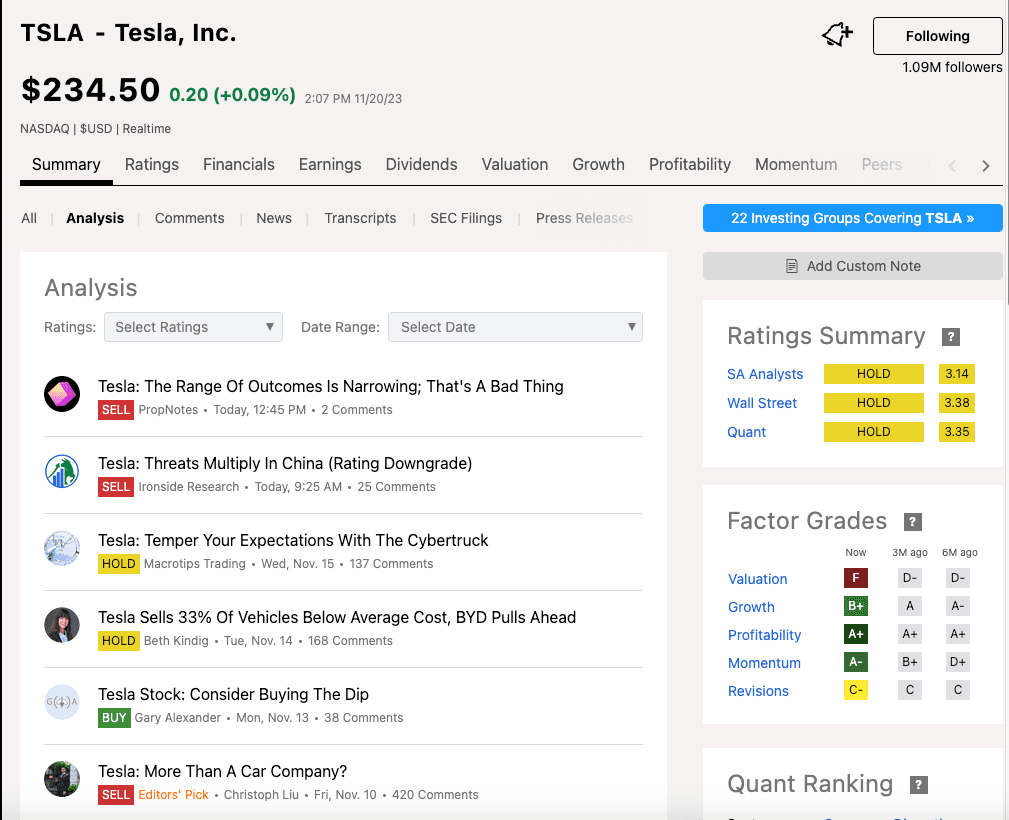
Seeking Alpha's Quant Ratings are arguably the platform's most powerful tool. The system evaluates every stock against its sector peers across five factors:
Value: Is the stock cheap or expensive relative to its sector?
Growth: How fast are revenue and earnings growing compared to peers?
Profitability: What are the margins and returns on capital?
Momentum: Is the stock trending up or down relative to other stocks in the same sector?
EPS Revisions: Are analysts raising or lowering their earnings estimates?

The Track Record Speaks for Itself
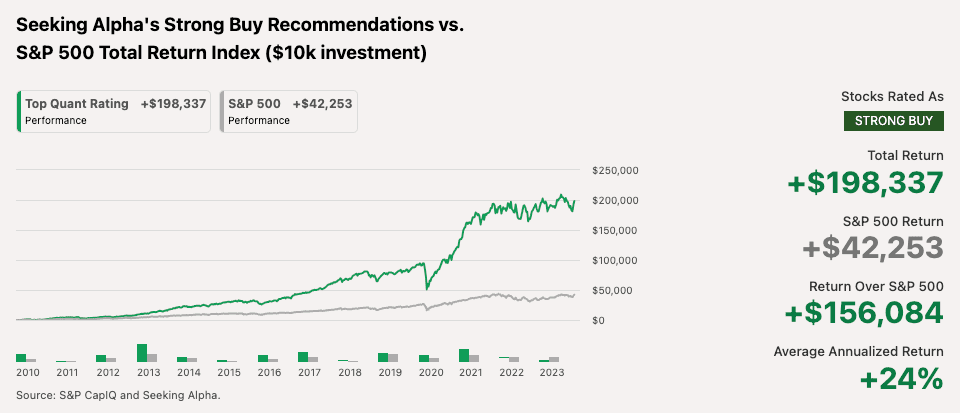
Seeking Alpha's Quant Ratings have a strong track record of beating the S&P 500. In backtesting since 2010, Strong Buy-rated stocks returned over 4,000% compared to roughly 500% for the S&P 500. That kind of outperformance is hard to ignore.
Ratings range from Strong Sell to Strong Buy. The system is weighted toward factors with the best historical track record of predicting stock performance, and stocks are compared within their own sector rather than against the entire market. A tech stock is compared to other tech stocks, not to utilities.
This sector-specific approach makes the ratings much more useful than generic stock scoring tools that compare Apple to ExxonMobil.
Author Track Records
Credibility matters when you're making investment decisions, and Seeking Alpha understands this. Every contributor's past performance is displayed alongside their articles, showing their historical accuracy on specific stock recommendations.
This isn't just a generic rating. You can see exactly how an author rated a particular stock, when they made the call, and what happened afterward. If a contributor has a 75% success rate on their Strong Buy picks over three years, that tells you something. If another has been wrong more often than right, that's equally useful information.
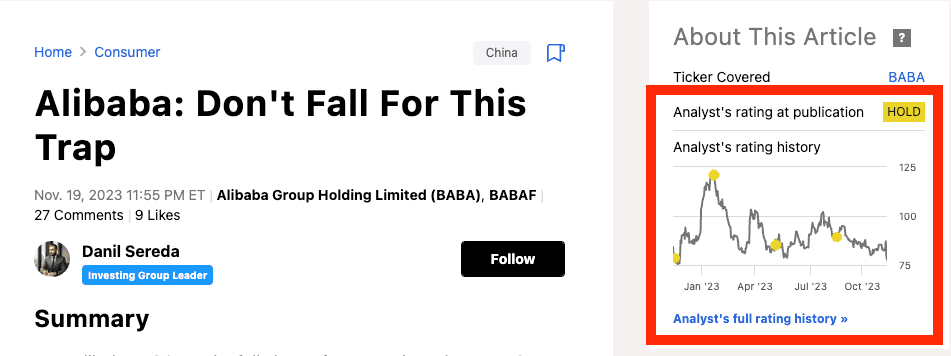
You can also dive into an author's full history of stock analysis and outcomes. This transparency ensures you're weighing advice from voices that have been tested in real market conditions, not just people who write convincingly.
Seeking Alpha Premium vs. Alpha Picks
One common question is whether you should get Seeking Alpha Premium vs Alpha Picks, or the bundle. Here's how they differ:
Premium ($299/year) is a research platform. You get tools to analyze stocks yourself: Quant Ratings, screeners, unlimited articles, earnings transcripts, and real-time alerts. It's for investors who want to do their own homework and make their own picks.
Alpha Picks ($499/year) is a stock-picking service. You get two quantitatively selected stocks per month and performance tracking. It's for investors who want someone (or something) to tell them which stocks to buy.
The Bundle ($639/year) gives you both at a $159 discount vs. buying separately. If you're interested in both research tools and curated picks, this is the most cost-effective option.
The key question: do you want to find your own stocks, or do you want picks handed to you? If you enjoy the research process, Premium alone is plenty. If you want a portfolio of quantitatively selected stocks that you can follow without doing deep analysis, Alpha Picks delivers. If you want both, the bundle saves you money.
Alpha Picks has posted impressive numbers. As of late 2025, 88 total picks averaged +89% returns, with 77% of all picks profitable. Sixteen picks had doubled or more, with top performers like APP (+1,571%), CLS (+1,166%), and SMCI (+968%). Those results significantly outpaced the S&P 500's +26% return over the same period.
High brokerage fees are eating your profits
Save thousands by choosing the best investment broker in 2026. Compare the options for free within minutes.
Compare investment brokers here!

Is Seeking Alpha Premium Worth It?
Yes, for the right investor. As a long-time subscriber who renews year after year, I can say that Seeking Alpha Premium pays for itself if you actively use it for stock research.
The combination of Quant Ratings, diverse contributor analysis, author track records, and the stock screener gives you a research toolkit that's hard to replicate anywhere else for $299/year. Even finding one good investment idea that you wouldn't have discovered otherwise can more than cover the subscription cost.
That said, you need to be realistic about what you're getting. Seeking Alpha Premium won't tell you which stocks to buy (that's what Alpha Picks does). It gives you the tools and information to make better decisions on your own. If you don't have the time or interest to read analyses and do your own thinking, you won't get $299 worth of value from the platform.
For experienced investors who are actively managing a portfolio of individual stocks, Seeking Alpha Premium is one of the best investments you can make in your investment education and decision-making process.
Seeking Alpha Premium vs. Alternatives
Seeking Alpha Premium isn't the only investment research platform out there. Here's how it stacks up against the most popular alternatives:
Motley Fool Stock Advisor ($199/year): Focuses on growth stock picks with a long-term buy-and-hold philosophy. Motley Fool is more beginner-friendly and less overwhelming, but you get significantly less depth. It's more of a stock-picking newsletter than a full research platform. If you want curated picks and simple guidance, Motley Fool works. If you want to do your own deep research, Seeking Alpha wins.
Morningstar Premium ($249/year): Strong on mutual fund and ETF analysis with their well-known star rating system. Morningstar's individual stock coverage uses a different methodology (fair value estimates from in-house analysts). Seeking Alpha offers far more diverse perspectives through its contributor model, while Morningstar gives you a single (but deeply researched) institutional viewpoint.
Yahoo Finance Premium ($349/year): Provides portfolio analytics, research reports, and financial data visualization. Good for data, but lacks the depth of stock analysis and community discussion that makes Seeking Alpha valuable. Yahoo Finance is better as a financial data terminal than as an investment research platform.
Seeking Alpha's unique advantage is the combination of quantitative ratings (Quant system) with qualitative analysis (10,000+ contributor articles per month). No other platform offers both at this price point.
How to Get Started With Seeking Alpha Premium
If you're considering a subscription, here's the approach I'd recommend:
Start with the free trial. Seeking Alpha offers a 7-day free trial for Premium. Use it to explore the Quant Ratings, read a few articles on stocks you're interested in, and test the stock screener. You'll know within a few days whether the platform fits your investment style.
Look for discounts. The full $299/year price often drops to $269 through promotional offers. Black Friday and New Year deals sometimes push it even lower. There's no reason to pay full price if you're patient.
Don't start with the Bundle. Try Premium first. If after a few months you find yourself wanting curated picks in addition to your own research, upgrade to the Bundle at that point. Starting with Premium alone lets you test the platform without committing $639 upfront.
Sources
FAQ
 What is Seeking Alpha?
Seeking Alpha is a crowd-sourced investment research platform founded in 2004. Independent contributors publish stock analyses, and the platform offers tools like Quant Ratings, Dividend Grades, and a stock screener. It has over 20 million monthly visits.
How much does Seeking Alpha Premium cost?
Seeking Alpha Premium costs $299 per year at the regular price. Promotional discounts often bring it down to around $269/year. Alpha Picks costs $499/year, and the Premium + Alpha Picks Bundle is $639/year. There is no monthly billing option for any plan.
Is Seeking Alpha Premium worth it?
For intermediate to advanced investors who actively research individual stocks, yes. The Quant Ratings alone have a strong backtested track record of outperforming the S&P 500. If you make even one better investment decision per year because of the platform, the subscription pays for itself.
What is the difference between Seeking Alpha Premium and Alpha Picks?
Premium ($299/year) is a research platform with Quant Ratings, stock screener, unlimited articles, and analysis tools. Alpha Picks ($499/year) is a stock-picking service that delivers two quantitatively selected stocks per month. Premium helps you find your own stocks. Alpha Picks tells you which stocks to buy.
Does Seeking Alpha offer a free trial?
Yes. Seeking Alpha offers a 7-day free trial for Premium that gives you full access to all features. Your card is charged after the trial period ends if you don't cancel.
How do Seeking Alpha Quant Ratings work?
Quant Ratings evaluate every stock against its sector peers across five factors: Value, Growth, Profitability, Momentum, and EPS Revisions. Stocks receive a rating from Strong Sell to Strong Buy. The system is weighted toward factors with the best historical track record of predicting stock performance.
Which is better, Seeking Alpha or Morningstar?
It depends on what you need. Seeking Alpha excels at individual stock analysis with diverse contributor perspectives and Quant Ratings. Morningstar is stronger for mutual fund and ETF analysis with their star rating system. For active stock pickers, Seeking Alpha is generally the better choice. For passive fund investors, Morningstar may be more useful.
Comments
Only registered users can leave comments.