
Blog article
Alternative Investments: Diversify Your Portfolio with EXANTE
Explore how alternative investments can reduce portfolio risk and unlock growth beyond stocks and bonds. See what EXANTE offers.
 Adheres to

 Adheres to
 7 Min read | Invest
Quick Take
Alternative investments include assets beyond stocks and bonds, such as commodities, real estate, private equity, and derivatives.
Diversifying into alternatives can reduce overall portfolio risk and provide returns that don't move in lockstep with the stock market.
The alternative investments market now exceeds $33 trillion in assets under management globally.
EXANTE is one platform offering access to over one million instruments across 50+ markets, though it does not currently accept U.S. clients.
If your portfolio is nothing but stocks and bonds, you're leaving money on the table. Alternative investments give you access to asset classes that move independently of Wall Street, which means better protection when the market drops and more ways to grow your wealth over time.
The catch? Most people don't know how to invest in alternative investments or where to start. This guide breaks down exactly what alternatives are, which types are worth considering, and how platforms like EXANTE make it easier to access them from a single account.
What Are Alternative Investments?
Alternative investments are any financial assets that fall outside the three traditional categories: stocks, bonds, and cash. They include a wide range of options like real estate, commodities, private equity, hedge funds, derivatives, precious metals, and even collectibles like art or wine.
The main appeal is diversification. Because alternatives often have a low correlation with the stock market, adding them to your portfolio can smooth out returns during periods of volatility. When the S&P 500 drops 20%, your gold holdings or commodity futures might hold steady or even gain value.
Total assets under management in alternative investments now exceed $33 trillion globally, according to J.P. Morgan research. That growth reflects a broader shift among both institutional and individual investors toward non-traditional assets.

Important Context
While alternative investments can enhance portfolio diversification, they typically carry higher risk and lower liquidity than stocks or bonds. Many alternatives also have higher minimum investments and more complex fee structures. Make sure you understand these tradeoffs before committing capital.
Why Diversify Beyond Stocks and Bonds?
The case for diversification is simple: putting all your money in one basket is risky. But true diversification goes beyond owning different stocks. It means holding assets that react differently to economic conditions.
Here's why alternatives matter for your portfolio:
Reduced correlation risk. When stocks crash, alternative assets like gold, real estate, or commodities often hold their value or even appreciate. This cushion can prevent your entire portfolio from cratering during a downturn.
Inflation protection. The U.S. dollar has lost significant purchasing power over the past five decades. Hard assets like precious metals and real estate tend to keep pace with or outpace inflation, protecting your buying power.
Access to different return drivers. Stocks are driven by corporate earnings. Real estate is driven by rental income and property values. Commodities are driven by supply and demand. By tapping into multiple return drivers, you're not dependent on any single economic force.
Portfolio stability. Research consistently shows that portfolios with a 10-20% allocation to alternatives tend to have better risk-adjusted returns than portfolios limited to stocks and bonds alone.
Types of Alternative Investments
The alternative investment universe is broad. Here are examples of alternative investments that are most commonly available to individual investors today:
Precious Metals
Gold, silver, platinum, and palladium serve as classic portfolio hedges. Gold in particular tends to rise during periods of economic uncertainty and has maintained its purchasing power for centuries. You can invest through physical bullion, ETFs, futures contracts, or mining stocks.
Commodities
Beyond metals, commodities include energy products (oil, natural gas), agricultural goods (wheat, corn, soybeans), and industrial materials (copper, lumber). Commodity prices are driven by global supply and demand rather than corporate performance, giving them a distinct return profile.
Real Estate
Real estate is the most accessible alternative for most investors. Options range from direct property ownership to Real Estate Investment Trusts (REITs) that trade like stocks. REITs are required to distribute at least 90% of taxable income as dividends, making them attractive for income-focused investors.
Options and Futures
Derivatives let you profit from price movements without owning the underlying asset. Options give you the right (not the obligation) to buy or sell at a set price. Futures contracts lock in a price for future delivery. Both require a solid understanding of the mechanics before trading.
Currencies (Forex)
The foreign exchange market is the largest financial market in the world, with over $7.5 trillion traded daily. Currency trading lets you profit from exchange rate movements between currency pairs like EUR/USD or GBP/JPY.
Private Equity and Venture Capital
These involve investing in private companies, either established firms (private equity) or startups (venture capital). Returns can be substantial, but your money is typically locked up for years and minimums are high.
Hedge Funds
Hedge funds pool investor capital and use sophisticated strategies like short selling, leverage, and arbitrage. They're typically limited to accredited investors and charge higher fees than traditional funds.

Getting Started
You don't need to be an accredited investor to get started with alternatives. ETFs that track commodities, real estate, or alternative strategies are available through any standard brokerage account with no minimum investment beyond the share price.
How Much Should You Allocate to Alternatives?
Financial experts generally recommend keeping alternative investments to 10-20% of your total portfolio. The best alternative investments for you depend on your risk tolerance, investment timeline, and how hands-on you want to be. Here's a rough framework:
Conservative investors (10% alternatives): Stick with precious metals ETFs and REITs. These are the most liquid and straightforward alternative assets.
Moderate investors (15% alternatives): Add commodity exposure and perhaps a small allocation to a liquid alternatives fund that uses hedge fund strategies in an ETF wrapper.
Aggressive investors (20% alternatives): Consider adding options, futures, or forex alongside the core alternatives. These require more knowledge and active management but offer higher return potential.
The key principle is that alternatives should complement your core holdings, not replace them. A well-diversified portfolio still needs a solid foundation of stocks and bonds.
High brokerage fees are eating your profits
Save thousands by choosing the best investment broker in 2026. Compare the options for free within minutes.
Compare investment brokers here!

EXANTE: A Global Alternative Investments Platform
EXANTE is a brokerage company headquartered in Cyprus that provides access to a wide range of global financial markets through a single platform.
What makes EXANTE notable is the breadth of its offerings. The platform provides access to over one million financial instruments across more than 50 markets, including stocks, bonds, ETFs, metals, futures, options, and currencies. You can trade across all of these from a single account.
EXANTE is regulated by CySEC (Cyprus), MFSA (Malta), the FCA (UK), and the SFC (Hong Kong). The platform serves clients in over 100 countries.

U.S. Availability
EXANTE does not currently accept U.S. citizens or residents as clients. If you're based in the U.S., consider platforms like Charles Schwab, Fidelity, or Interactive Brokers for access to alternative investments including commodities, options, futures, and international markets.
EXANTE at a Glance
| Broker | EXANTE |
|---|---|
| Operated By | EXT LTD |
| Official Website | https://exante.eu/ |
| Financial Instruments | 1,000,000+ |
| Asset Types | Stocks, ETFs, Metals, Futures, Options, Funds, Bonds, Forex |
| Markets | 50+ |
| Minimum Deposit | 10,000 EUR (individuals) / 50,000 EUR (corporations) |
| Regulated By | FCA (UK), CySEC (Cyprus), MFSA (Malta), SFC (Hong Kong) |
| Headquarters | Limassol, Cyprus |
| Countries Served | 100+ (excludes U.S., Japan, Russia, Belarus, Iran, DPRK) |
| Inactivity Fee | 50 EUR/month after 181 days of no trading |
| Withdrawal Fee | 30 EUR per withdrawal |
Alternative Investment Options on EXANTE
EXANTE provides access to several categories of alternative investments, making it a one-stop platform for investors looking to diversify beyond traditional stock and bond portfolios.
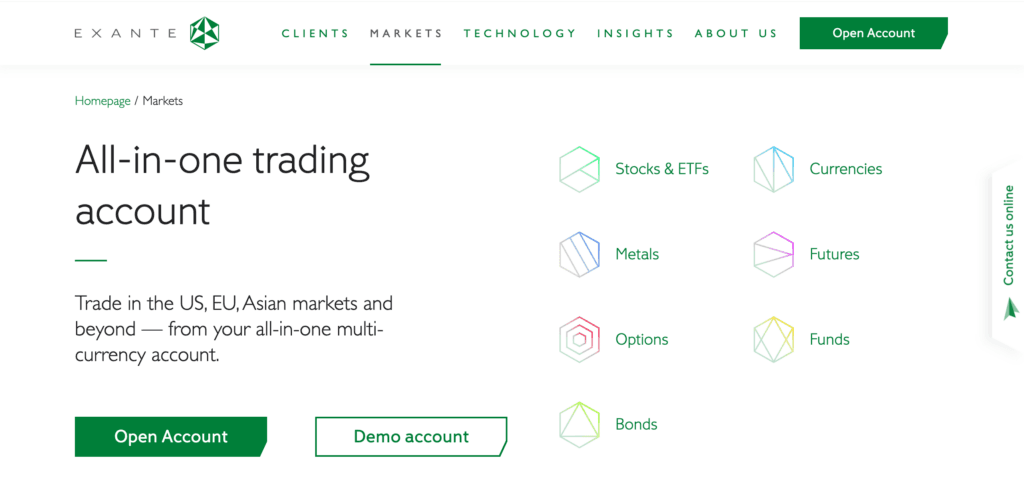
Metals
EXANTE offers direct trading in precious and industrial metals: gold, silver, platinum, palladium, and copper. These provide a hedge against inflation and currency devaluation, with low correlation to equity markets. Trading fees start from $3 per trade.
Options
The platform supports options trading across major global exchanges, including the CBOE, CME, EUREX, and the Hong Kong Exchange. Options fees start from $1.50 per contract.
Currencies (Forex)
EXANTE supports up to 50 currency pairs for forex trading, with spreads starting from 0.3 pips. Major pairs like EUR/USD, GBP/USD, and USD/JPY are available alongside less common pairs.
Funds
Access to a selection of hedge funds and investment funds that employ strategies designed to deliver returns regardless of broader market conditions.
EXANTE Fee Summary
| Metals | From $3 |
|---|---|
| Forex | From 0.3 pips spread |
| Options | From $1.50 per contract |
| Funds | From 0.5% |
| Deposits | Free |
| Withdrawals | 30 EUR flat fee |
EXANTE: Pros and Cons

Massive selection: Over 1 million instruments across 50+ markets worldwide
Single account access: Trade stocks, bonds, options, futures, metals, and forex from one platform
Multi-regulator oversight: Licensed by FCA, CySEC, MFSA, and SFC
Free deposits: No fees to fund your account
Advanced tools: Professional-grade trading tools and analytics

High minimum deposit: 10,000 EUR minimum makes it inaccessible for beginning investors
No U.S. access: Does not accept U.S. citizens or residents
Inactivity fee: 50 EUR monthly charge after 181 days without a trade
Steep learning curve: The sheer number of instruments and markets can overwhelm new investors
Alternative Investment Platforms for U.S. Investors
Since EXANTE doesn't serve U.S. clients, here are platforms that do offer access to alternative investments:
Interactive Brokers provides access to options, futures, forex, metals, and international markets with low commissions and no inactivity fees. It's the closest U.S.-available equivalent to EXANTE's multi-asset approach.
Charles Schwab offers commodity and options trading alongside its standard stock and ETF offerings. Schwab also provides access to alternative investment ETFs and real estate investment trusts.
Fidelity has a growing selection of alternative investment options, including crypto, options, and alternative strategy ETFs. The platform is beginner-friendly with strong educational resources.
For investors specifically interested in alternative asset classes, specialized platforms like Fundrise (real estate), Masterworks (art), and Coinbase (crypto) focus on individual alternative categories.
Risks of Alternative Investments
Before adding alternatives to your portfolio, understand the risks involved:
Liquidity risk. Many alternatives can't be sold quickly. Private equity investments may lock up your capital for 5-10 years. Even commodity futures have settlement dates that restrict when you can exit.
Complexity risk. Options, futures, and forex require understanding leverage, margin requirements, and contract specifications. Getting these wrong can lead to losses that exceed your initial investment.
Higher fees. Hedge funds typically charge "2 and 20" (2% management fee plus 20% of profits). Even alternative ETFs tend to have higher expense ratios than broad market index funds.
Valuation challenges. Unlike publicly traded stocks with real-time pricing, many alternatives (private equity, real estate, collectibles) are difficult to value accurately.
Regulatory differences. Alternative investments often face less regulatory oversight than traditional securities. This means less investor protection if something goes wrong.
Bottom Line
Alternative investments are a legitimate way to build a more resilient portfolio. By spreading your capital across asset classes that don't all move in the same direction, you reduce your exposure to any single market downturn.
For non-U.S. investors, platforms like EXANTE provide convenient access to metals, options, currencies, and funds through a single account. U.S. investors can access similar alternative assets through Interactive Brokers, Schwab, or Fidelity.
The key is starting small. Allocate 10-15% of your portfolio to alternatives, stick with the most liquid options (ETFs, REITs, and commodity funds), and expand into more complex instruments only after you understand the risks involved.
Disclaimer: The information in this article is for educational purposes only. It is not financial, investment, or legal advice. Consult a certified financial professional before making investment decisions.
Frequently Asked Questions
 What are the most common types of alternative investments?
The most common types include real estate (REITs), commodities (gold, silver, oil), private equity, hedge funds, derivatives (options and futures), currencies (forex), and collectibles like art or wine. ETFs that track alternative asset classes are the easiest way to get started.
Are alternative investments riskier than stocks?
It depends on the specific asset. REITs and commodity ETFs carry risk levels similar to stocks. Options, futures, and forex can be significantly riskier due to leverage. Private equity and hedge funds have additional risks from illiquidity and high minimum investments. The key is understanding each alternative's risk profile before investing.
How much of my portfolio should be in alternative investments?
Most financial experts recommend limiting alternatives to 10-20% of your total portfolio. Conservative investors should stay closer to 10%, while those with higher risk tolerance and more investment experience might go up to 20%. Start small and increase your allocation as you become more comfortable with each asset class.
What sets EXANTE apart from other brokers?
EXANTE provides access to over one million financial instruments across 50+ global markets from a single account. It covers stocks, bonds, ETFs, options, futures, metals, forex, and funds. The platform is regulated by four different regulatory bodies (FCA, CySEC, MFSA, SFC). However, it requires a minimum deposit of 10,000 EUR and does not accept U.S. clients.
Can U.S. investors access alternative investments?
Yes. U.S. investors can access alternative investments through domestic brokers like Interactive Brokers, Charles Schwab, and Fidelity. These platforms offer options, futures, commodity trading, and alternative investment ETFs. Specialized platforms like Fundrise (real estate) and Coinbase (crypto) focus on specific alternative asset categories.
Comments
Only registered users can leave comments.