Loan Amortization is the process of spreading out a loan into fixed payments over a set period, with each payment covering both interest and principal. In the early stages of an amortized loan, a larger portion of each payment is directed towards interest, gradually shifting more towards the principal as the loan matures. Making extra payments towards the principal can significantly reduce the total interest paid and potentially shorten the overall loan term.
we can't guarantee the complete accuracy on a day-to-day
Filters
Loan amount
Minimum annual revenue
Minimum years in business
Interest rate type
Product form
Required documents
Product Statistics
A complete breakdown of all data points across the products in this comparison to help you make the right decision.
Credit line
7 (77.8%)
Loan amount
$400 - $20,000,000 ($2,673,355.56)
Loan period
2 months - 304 months (73 months)
Annual interest rate
3.75% - 99% (35.6%)
Nominal interest rate
1% - 25% (4.19%)
Minimum annual revenue
$0 - $250,000 ($113,777.78)
Minimum years in business
0 - 1 (0.78)
Accepts startups
5 (55.6%)
Collateral required
1 (11.1%)
Personal collateral required
0 (0%)
Tax returns
7 (77.8%)
Business plan
4 (44.4%)
Bank statement
9 (100%)
Financial statement
7 (77.8%)
National bank account
9 (100%)
National phone number
9 (100%)
Electronic identification
7 (77.8%)
Headquarters in the country
9 (100%)
P2P Lender
0 (0%)
Weekend Payout
0 (0%)
Loan extensions
7 (77.8%)
Early payback
9 (100%)
Loan broker
6 (66.7%)
Approval rate
60% - 93% (75.17%)
Payment protection insurance
0 (0%)
Revocation period
0 (0%)
Statistics based on 9 Business loans products in our database.
CompanyLowestHighest
1West5%36%
National Funding4%39%
Fundera6%99%
Credibly10%40%
Nav3.75%99%
Uplyft Capital10%93.08%
Fora Financial20%99%
Blue Bridge Financial6.99%25%
Torro9%36%
Interest Rates
See how rates compare across all providers. The bars show the range between lowest and highest rates offered by each company.
Financer's Choice
Top Rated
1West
Rates start at 5% for accounts receivable financing but climb to 18%+ for unsecured working capital. Above average for many products, though competitive for SBA and equipment loans.
1West provide responsive service with their "ABLE" platform combining automation with expert support. Customers have access to dedicated advisors if needed, providing a good balance of self-service and personalized assistance.
Clear qualification requirements and transparent loan terms across multiple products. Flexible financing options with varying terms. Streamlined application process with minimal documentation required.
4.8 stars on Trustpilot from 1,300+ reviews with 91% giving 5 stars. Customers praise named agents and fast turnaround. A few reviewers note communication gaps after contracts are signed.
Get exclusive conditions from the best financial companies
What is Loan Amortization?
Certain financial terms can often feel like they're designed to confuse rather than clarify. Amortization is one such term.
In the most basic sense, amortization is the process of spreading out a loan into a series of fixed payments over time.
These payments are structured so that you're paying off both the interest and the principal (the original amount borrowed) gradually.
The Amortization Schedule: Your Loan Roadmap
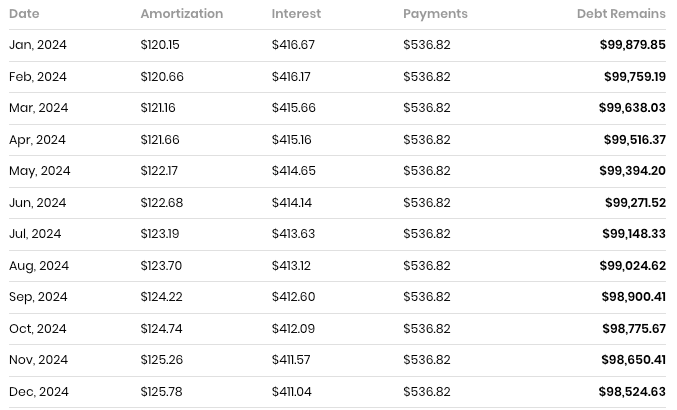
The real heart of amortization is the amortization schedule. This is a table detailing each payment throughout the life of the loan. It shows:
The total payment amount.
How much of each payment goes towards the interest.
How much is applied to the principal.
The remaining balance after each payment.
In the early stages of your loan, a larger portion of your payment is devoted to interest. As time goes on, this shifts, and more of your payment goes towards reducing the principal.
Why Does Front-Loaded Interest Matter?
This front-loaded interest structure has some implications:
Equity Building: In the early years of a loan, you're building equity at a slower pace. This is crucial to understand, especially for those who might consider selling their asset (like a house) within a few years of purchase.
Refinancing Considerations: If you're contemplating refinancing, it's essential to understand where you are in your amortization schedule. Refinancing early in the term might mean you're restarting the cycle of high-interest payments.
Prepayment Benefits: Making extra payments towards the principal early in the loan can significantly reduce the total interest you pay over the life of the loan.
Different Types of Amortization
Amortization can vary in structure depending on the type of loan and the specific terms agreed upon between the borrower and lender.
Understanding these different types of amortization is crucial for borrowers, as it affects how payments are calculated and the overall cost of the loan.
Type of Amortization
Impact on Borrower
Payment Progression
Risks/Benefits
Annuity Amortization
Fixed payment amount, easy budgeting
Starts with higher interest, transitions to higher principal
Predictable payments; more interest paid initially
Straight-Line Amortization
Consistent principal repayment
Decreasing total payment as interest reduces
Easy to track principal reduction; potentially higher initial payments
Declining Balance Amortization
Decreasing payment amount over time
Starts high, reduces as loan matures
Lower payments later in loan term; higher initial financial burden
Balloon Payment Amortization
Lower payments until term end
Consistent payments followed by one large payment
Risk of large end payment; refinancing may be necessary
Negative Amortization
Initially lower payments, increasing balance
Payment less than interest; balance grows
Can lead to increased debt; careful management required
Interest-Only Amortization
Interest payments only initially
Only interest initially, then switches to include principal
Lower initial payments; higher payments later
Annuity Amortization: The Standard for Mortgages
The most popular type of amortization for mortgages is the Annuity Amortization. This method is also commonly referred to as the "traditional" or "standard" amortization schedule. Here's why it's widely used:
Fixed Payments: Annuity amortization schedules involve fixed payments over the term of the loan. This means that borrowers pay the same amount every month, which helps in budgeting and financial planning.
Composition of Payments: In the early years of the mortgage, a larger portion of each payment goes towards paying interest. As time progresses, a greater portion of the payment is applied to the principal. This is because the interest is calculated on the remaining principal, which decreases with each payment.
Predictability and Stability: This method provides a predictable and stable payment structure, which is particularly appealing for residential mortgages. Homeowners appreciate knowing exactly what their payments will be for the life of the loan, without worrying about payment amounts changing.
Full Amortization: These loans are fully amortized, meaning that if all payments are made as scheduled, the loan will be completely paid off at the end of the term. There is no balloon payment or lump sum due at the end.
Flexibility in Terms: Mortgages with annuity amortization can come in various term lengths, such as 15, 20, 30, or even 40 years, providing flexibility for borrowers to choose a term that best fits their financial situation.
Widespread Availability: This type of amortization is the standard in the industry, offered by most lenders for residential mortgages. It's well-understood, highly regulated, and comes with various consumer protection features.
Characteristics: In straight-line amortization, the principal payment remains constant throughout the term of the loan. The interest payment decreases over time as the principal balance reduces.
Common Usage: This method is often used in personal loans and some types of business loans.
Declining Balance Amortization
Characteristics: Payments are larger at the beginning of the loan term and gradually decrease over time. The decrease is due to the interest being calculated on a declining principal balance.
Common Usage: This method is less common but can be found in some types of installment loans or business loans.
Balloon Payment Amortization
Characteristics: In this type, regular payments of interest and possibly some principal are made for a set period, followed by a large 'balloon' payment at the end of the loan term. This final payment covers the remaining principal balance.
Characteristics: This occurs when the loan payments are set below the amount needed to cover the interest cost. As a result, the unpaid interest is added to the principal balance, causing the loan balance to increase over time rather than decrease.
Common Usage: It's found in some adjustable-rate mortgages but is generally considered risky for borrowers.
Interest-Only Amortization
Characteristics: In this structure, borrowers pay only the interest on the loan for a certain period. After this phase, the loan typically converts to a standard amortizing loan, where payments include both principal and interest.
Common Usage: This is often used in certain types of mortgages and investment loans.
Amortization Calculations Explained
Understanding amortization calculations is essential for any borrower, as it provides insight into how loan payments are allocated towards principal and interest over the life of the loan.
But rather than pulling out your own calculator, click here to leverage our loan amortization calculator, which simplifies this process significantly. Here's a brief overview of how these calculations work and how our calculator can assist you.
Essential Components of Amortization Calculations
Loan Amount: The initial sum borrowed.
Interest Rate: The rate at which interest is charged on the loan, usually an annual rate but calculated monthly.
Loan Term: The duration over which the loan will be repaid, often in years.
The Amortization Formula
To calculate monthly payments for a fixed-rate loan, we use a specific formula that considers the principal, interest rate, and loan term:
Input the Loan Details: Enter the total loan amount, annual interest rate, and loan term in years.
Automatic Calculation: The calculator automatically converts the annual interest rate to a monthly rate and determines the total number of payments.
Instant Breakdown: It then applies the amortization formula and provides you with the monthly payment amount, alongside a detailed breakdown of how much goes towards the principal and interest.
Visualizing with an Amortization Schedule
The calculator also generates an amortization schedule, offering a clear view of how each payment is divided over the loan term.
This schedule is particularly helpful in visualizing the shift from primarily interest-focused payments to principal-focused payments as the loan matures.
Breakdown of 1st year Payments for a 30 year $100,000 Mortgage at 5%
What You Need to Know About Amortization
When navigating the waters of loan amortization, borrowers often focus on the surface details — monthly payments and interest rates.
However, truly understanding the concept of amortization reveals strategic opportunities that can have a significant impact on one’s financial journey. Here's an insightful perspective on amortization that every savvy borrower should consider.
Equity Building vs. Interest: The Early Years' Trade-off
The initial stage of an amortized loan is skewed towards interest payments. This structure often surprises borrowers, as they see their principal balance decrease only marginally despite regular payments.
Understanding this front-loaded interest phenomenon is key to making informed financial decisions, such as the potential benefits of making additional principal payments early in the loan term to accelerate equity building and reduce total interest paid.
The Power of Prepayments
One of the most impactful strategies in loan amortization is making prepayments. Even small additional amounts towards the principal can shorten the loan term and cut down the total interest significantly.
Borrowers should use amortization schedules to forecast the effects of additional payments and consult with their lender about any potential prepayment penalties.
Refinancing: A Double-Edged Sword
Refinancing can seem like a beacon of relief when interest rates drop, offering lower monthly payments or a shorter loan term. However, it’s essential to consider the reset of the amortization schedule that accompanies refinancing.
A new loan means that payments are once again applied more heavily towards interest. Calculating the break-even point and long-term cost implications is a must before taking this step.
Adjustable-Rate Mortgages (ARMs) and Amortization
ARMs add a layer of complexity to amortization. Initially, these loans may offer lower payments, but as interest rates fluctuate, so will the payments and the loan’s amortization schedule.
Borrowers with ARMs should be financially prepared for the possibility of increased payments and a changing amortization timeline.
Amortization in Investment Properties
For investment property owners, amortization holds additional implications, particularly when it comes to taxes. The ability to deduct mortgage interest can be a significant financial benefit.
Additionally, understanding how amortization affects cash flow and the return on investment for rental properties is critical for long-term financial planning.
The Long-Term Perspective
Amortization schedules are not just a monthly roadmap; they are a long-term financial planning tool. Borrowers should periodically review their amortization schedule alongside their financial goals.
Life changes — such as income fluctuations, changes in family dynamics, or shifts in the housing market — may warrant a reassessment of one’s loan strategy.
FAQs about Amortization
What exactly is amortization?
Amortization is the process of paying off a debt over time through regular payments. A part of each payment goes towards the interest, and the remaining amount reduces the principal balance.
How does an amortization schedule work?
An amortization schedule outlines each payment on a loan over time, showing how much goes towards interest and how much goes towards reducing the principal. Initially, payments are mostly interest, but over time more of your payment goes to the principal.
Why do early payments mostly go toward interest?
Lenders calculate interest based on the remaining balance of the loan. In the early stages of repayment, the principal balance is highest, so the interest portion of the payment is greater.
Can I save money by making extra payments on my loan?
Yes, making additional payments towards the principal can reduce the total amount of interest paid over the life of the loan and can potentially shorten the loan term.
Does refinancing affect amortization?
Refinancing can reset the amortization schedule, often resulting in a return to payments that are predominantly interest. It's important to calculate whether refinancing will offer a true cost benefit over the course of the loan.
Are there different types of amortization for different loans?
Yes, there are several types of amortization, including straight-line (linear), declining balance, balloon payment, negative amortization, and interest-only, each with unique payment structures and implications.
What type of amortization is most common for mortgages?
The most common type for mortgages is annuity amortization, where payments are fixed over the term and gradually shift from being interest-focused to principal-focused.
How can I calculate my monthly loan payment?
Monthly loan payments can be calculated using the amortization formula, which factors in the loan amount, interest rate, and term of the loan. Alternatively, you can use online calculatorsto simplify this process.
Is it better to have a shorter or longer amortization period?
This depends on your financial situation. A shorter amortization period means higher monthly payments but less interest over time. A longer amortization period reduces monthly payments but increases the total interest paid.
How does amortization affect my taxes?
For some loans, like certain mortgages, the interest part of the payment may be tax-deductible. The implications vary widely based on local tax laws and the loan type, so consult a tax professional for advice specific to your situation.
Can I change my amortization schedule?
Yes, you can change your amortization schedule by refinancing the loan, making extra payments, or adjusting the terms with your lender. However, each of these options may have financial implications that should be considered carefully.
Financer Talks
Do you have a question about this topic? Ask the community.